


With increasingly congested environments, every second counts in traffic management. A panel that communicates clearly can save you from a traffic jam—or from something far worse. In tunnels, complex access points and dense traffic, what drivers see on the sign and how quickly they understand it makes all the difference. That’s why we design panels that speak your language: clear, immediate, effective.
What worked in the past—segmented signs with limited message options—ultimately falls short of today’s demands for safety, regulation and real-time traffic management. In this context, upgrading to Full Matrix VMS is no longer a cosmetic enhancement; it’s a strategic decision.
In this article, we’ll explore why moving toward Full Matrix technology makes sense, what current regulations require, and how to plan a replacement strategy that brings real value to your road network.
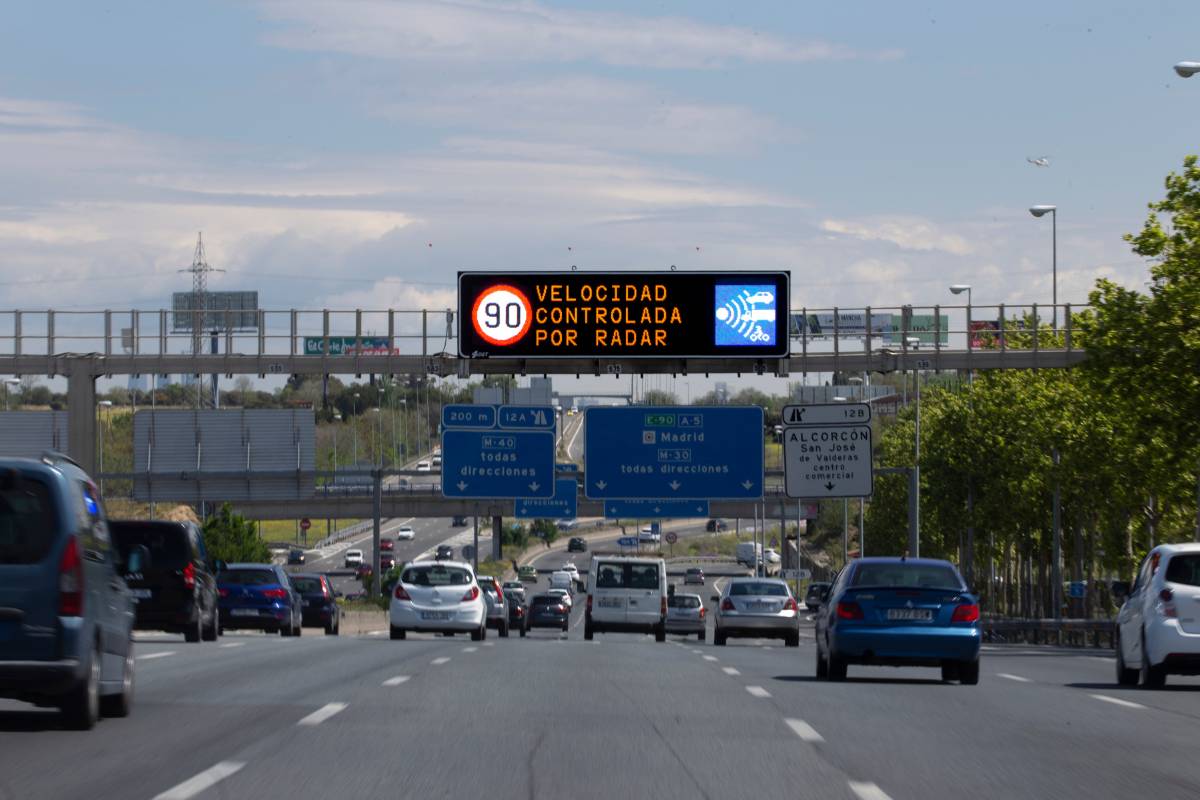
UNE-EN 12966:2005 Standard for VMS signs
Why upgrade your Variable Message Signs?
Let’s start with the obvious: if your current VMS panels “work,” why replace them? The answer has three dimensions: technical, regulatory, and strategic.
Limitations of current VMS
Panels installed ten or even five years ago are typically based on discrete character technology. That means a limited number of predefined characters, fixed pictograms and very little visual adaptability.
Although they’ve served their purpose, they show clear limitations compared to Full Matrix VMS:
- Inflexible messages, restricted to rigid templates
- Static pictograms that are hard to adapt to new situations
- Reduced legibility when combining text, symbols and speed indications in limited space
In an environment where decisions must be made in seconds, asking drivers to “decode” a sign becomes a risk.
Evolving Safety and Traffic Management Needs
Traffic density has increased, mobility patterns have changed, and drivers’ expectations have evolved. A 2026 driver expects clear, immediate and contextualized information. A generic “Caution” message is not enough when what truly matters is knowing whether the left lane is closed for roadworks or if there’s an accident 500 meters ahead.
VMS full matrix technology enables exactly that: dynamic messages that adapt to real-time conditions. You can combine text, custom pictograms, directional arrows and color codes to convey complex information instantly.
Alignment with European ITS Standards
Europe is rapidly advancing toward interconnected Intelligent Transport Systems (ITS). Spain, through the Dirección General de Tráfico (DGT) and the Ministry of Transport and Sustainable Mobility, is progressively adopting these standards.
If your infrastructure isn’t aligned with modern ITS systems, you’re excluded from the intelligent network. And this is not a distant future scenario: cooperative C-ITS systems (vehicle–infrastructure communication) are already in deployment. Upgrading now to Variable Message Signs Full Matrix technology ensures your infrastructure is ready for seamless integration without needing new short-term investments.
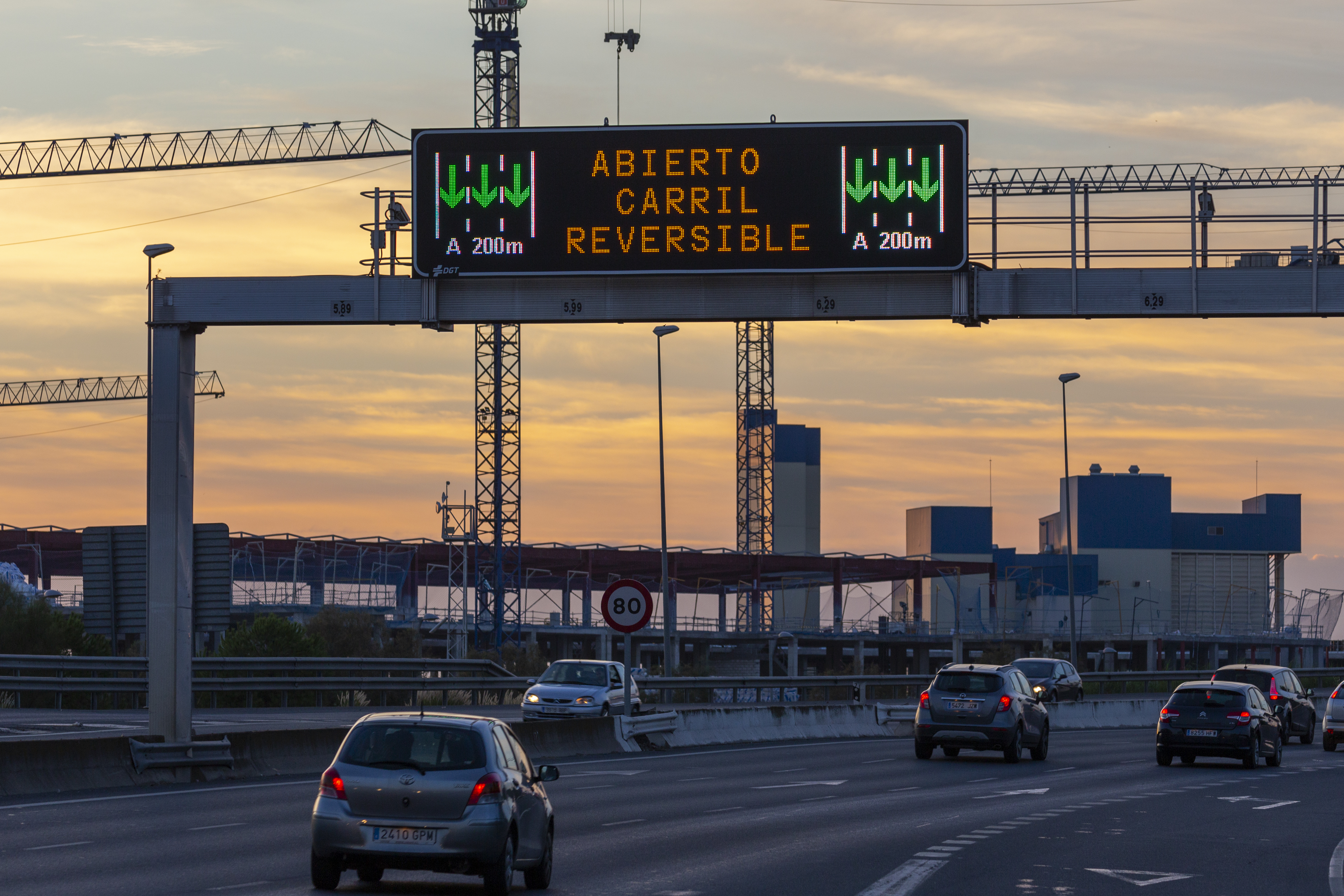
Full Matrix variable message sign indicating the opening of the reversible lane 200 metres ahead.
What is Full Matrix technology and how does it work?
The shift from discrete-character systems to continuous digital matrix displays represents a fundamental paradigm change in variable signage.
It was precisely the Full Matrix technology developed by Fixalia that demonstrated the revolutionary potential of these systems, accelerating the adoption of higher standards across the sector. Recognizing this advancement, the DGT established the DGT+ protocol, which defines the technical and operational standards required to unlock the full capabilities of Full Matrix VMS. This protocol—born from the innovation Fixalia introduced to the market—ensures that equipment delivers its full performance, enabling operators to implement truly dynamic and contextualized communication strategies.
Differences between Discrete, Matrix and Full Matrix VMS
Discrete-character panels use predefined LED modules that can only display preset characters and symbols. They can show numbers and letters but offer limited messaging options.
Matrix panels combine alphanumeric text zones with fixed pictogram areas. They are an improvement over discrete systems but remain graphically constrained by predefined layouts.
Full Matrix VMS, by contrast, act as a continuous canvas. Each LED behaves as an individual pixel that can be switched on or off independently. This allows you to create any message, graphic or pictogram without format limitations.
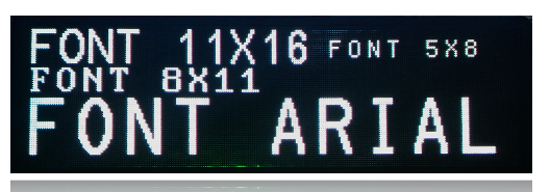
Discrete-character panels
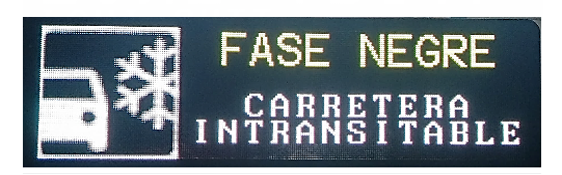
Matrix Panel
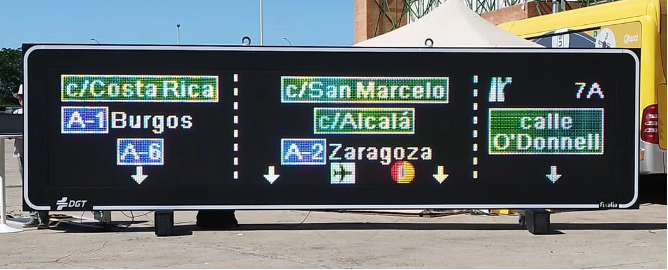
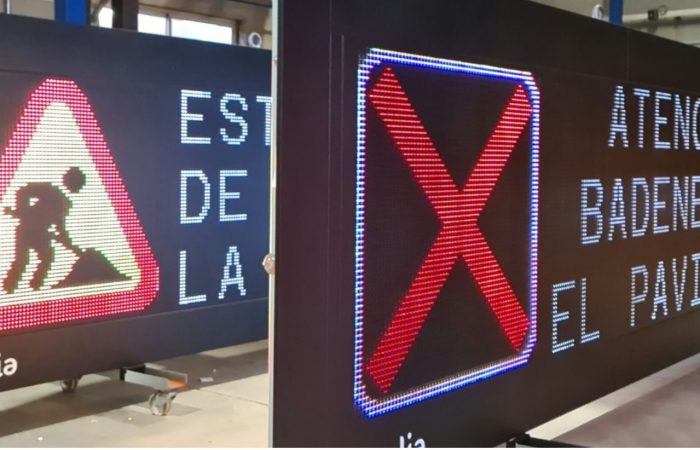
Full Matrix panel divided into three sections, each showing different traffic information with text, arrows and color LED pictograms.
How the continuous LED Matrix works
Everything revolves around the canvas:
- Each LED (or LED group) is individually controlled
- Management software determines which points light up, in what color and at what intensity
- The result is a “graphic display” optimized for road use, offering high luminance, contrast and uniformity
Technical advantages of Full Matrix VMS
This is where the investment begins to make economic sense—not just technical sense.
Total flexibility for messages and pictograms
Imagine this scenario: there’s an accident in the central lane of an urban tunnel, requiring a temporary diversion to the service lane. With a segmented panel, your message will be generic: “Accident – Reduce speed.”
With a VMS full matrix, you can display a visual layout of the tunnel, indicate exactly which lane is affected, add a directional arrow toward the diversion, and update the message in real time as the incident evolves.
This is not science fiction, it’s modern traffic management. And in critical situations, the difference between a clear message and an ambiguous one can prevent secondary accidents.
Greater legibility and communication efficiency
Research is conclusive: legibility matters—a lot. The study by Huo et al. (2024) specifically analyzed VMS legibility in fog conditions, showing that contrast, spacing and text color are key determinants of comprehension.
Full Matrix Variable Message Signs allow all these parameters to be dynamically adjusted. You can enlarge characters under low-visibility conditions, invert colors when there is sun glare, or use high-contrast pictograms instead of text when reading speed is critical.
Enhanced road safety in critical environments
Critical areas—tunnels, motorway access points, weaving zones, construction zones—are where risk concentrates. Here, timely and clear information is not a luxury; it’s an operational requirement.
Full Matrix VMS enable:
- Contextualized alerts: not just “Danger,” but “Danger – Vehicle stopped in right lane 300m.”
- Progressive messaging: advance information provided at longer distances, with increasing detail as drivers approach
- Weather-adaptive communication: specific messages for heavy rain, ice, fog or strong winds
- Multilingual messaging: ideal for tourist areas or border regions, switching languages automatically
All of this reduces driver uncertainty, minimizes sudden maneuvers and improves traffic flow even in complex scenarios.
Energy efficiency and optimized maintenance
Here’s the economic argument every infrastructure manager needs: modern Full Matrix VMS consume less energy than many older systems thanks to next-generation LED technology.
But there’s more: the modularity of the components enables quick, targeted interventions. If an LED module fails, it can be replaced without dismantling the entire panel. Remote diagnostic systems detect issues before they affect operations, enabling preventive instead of corrective maintenance.
This means:
- Fewer maintenance team deployments
- Less downtime for the panel
- Reduced operating costs in the medium and long term
If you calculate the TCO (Total Cost of Ownership) of a Full Matrix Variable Message Signs vs. an older panel requiring frequent maintenance, the economic equation clearly favors modernization.
Integration with ITS and C-ITS Systems
This is the point many managers underestimate but it will be critical in the coming years. Full Matrix VMS are designed to integrate with existing ITS platforms and, more importantly, with future cooperative C-ITS systems.
What does this mean in practice? Your VMS can receive real-time data directly from:
- Traffic sensors
- CCTV systems with automatic incident detection
- Integrated weather systems
- Central traffic management platforms
- Future vehicle-to-infrastructure communication systems
Smart infrastructure is not an abstract concept—it’s a connected network of devices working in coordination. Investing in Variable Message Signs Full Matrix today guarantees compatibility with future mobility developments without requiring costly upgrades.
To better understand the current regulatory framework for variable signage, consult our article on the UNE-EN standard for variable message signs.
Do you need
Full Matrix Variable Message Signs?
Tell us about your project and we will advise you on the best smart signage solution.
Operational impact: how Full Matrix VMS improve traffic management
Let’s move from theory to day-to-day operations. When an incident occurs—an accident, breakdown, or debris on the road—every minute counts.
Full Matrix VMS allow control centers to update messages in real time, specifying exactly what is happening, where, and what action the driver should take. As the situation evolves (lane cleared, diversion activated, traffic normalizing), the message updates instantly, significantly reducing secondary congestion, chain-accident risks and driver frustration.
Rapid incident response
At critical decision points—motorway entries, bifurcations, tunnel portals—clear information makes the difference between fluidity and chaos.
Full Matrix VMS can show visual layouts of the roadway with directional arrows, lane-by-lane travel-time comparisons (“Left lane – 15 min delay” vs. “Right lane – Free-flow”), and context-specific alerts. In complex or high-density infrastructures, this clarity enhances both safety and road capacity.
In summary:
- Greater safety thanks to more adaptive, precise messages.
- Better real-time traffic management during incidents, roadworks and peak congestion.
- A cutting-edge technological image aligned with European mobility standards.
- Future-readiness for connected vehicles and cooperative systems (C-ITS).
Where should you prioritize replacement?
Not all locations require the same level of investment. This is where strategy comes into play: prioritize points where the impact will be greatest. Replacement is especially recommended where:
- Legibility issues or obsolete technology exist
- High messaging flexibility is required (access points, weaving zones, diversion areas)
- High incident or accident rates have been recorded
- Advanced ITS or cooperative management integration is needed
Conclusion: a strategic step towards smart mobility
Upgrading Variable Message Signs to Full Matrix VMS is not only a technical requirement but a strategic modernization decision aligned with Spain’s and Europe’s evolution in roadway signage.
This shift toward Full Matrix Variable Message Signs will enhance road safety, optimize urban traffic management, ensure compliance with new DGT regulations and prepare your infrastructure for the challenges of future smart mobility.
For all these reasons, we recommend including the progressive replacement of existing VMS with Full Matrix models in upcoming investment budgets, prioritizing locations justified by operational, safety or communication-efficiency needs.
Ready to modernize your Variable Message Signs?
At Fixalia, we’ve spent years supporting administrations and infrastructure managers in their transition to intelligent signage systems. We understand the technical challenges, regulatory complexities and real-world budget constraints.
Request a no-obligation technical assessment and discover how Full Matrix technology can improve the safety and efficiency of your infrastructure.