


The tunnel variable message signs regulations in Spain establish a rigorous technical-legal framework that guarantees the safety of millions of drivers every year.
However, knowing the applicable rules is not enough: understanding their purpose, their specific requirements, and how they interrelate makes the difference between a project that complies on paper and one that works effectively in real-world conditions.
In this guide, we analyse the current tunnel VMS regulations in depth, from Royal Decree 635/2006 to the UNE-EN technical specifications, with the aim of helping you understand not only what the law requires, but why it requires it and how we help you apply it correctly in your project.
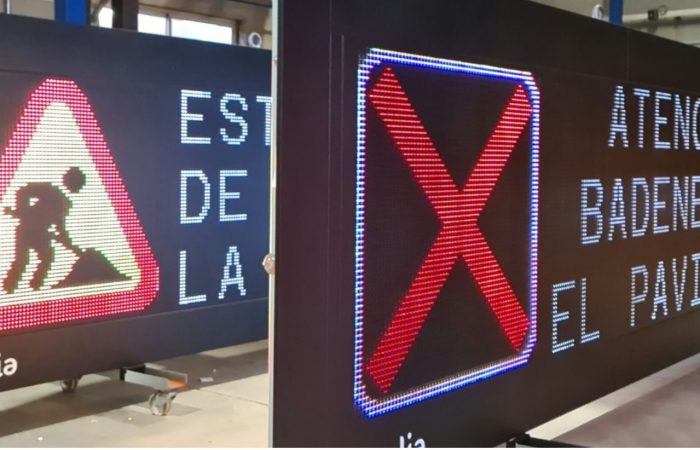
UNE-EN 12966:2005 Standard for VMS signs
Why regulations for tunnels are important
Tunnels are one of the most demanding environments in road infrastructure: they concentrate gases, limit evacuation routes, and present lighting and visual conditions that require highly reliable signalling. For this reason, tunnel variable message signs regulations are not merely an administrative formality, but a technical response to the specific risks of these spaces, designed to protect driver safety and facilitate traffic management in any circumstance.
Every regulatory requirement (from a panel’s luminance levels to communication protocols with the control centre) has a technical and operational basis. Royal Decree 635/2006 and its updates have driven numerous tunnel adaptation projects in recent years, demonstrating that regulatory compliance is not limited to new constructions, but forms part of a continuous process of road safety improvement and modernisation.
Discover our variable mobility panel solution for tunnels
The three regulatory pillars (and how they translate to your project)
- Safety legal framework: Defines which tunnels must have variable signalling and the minimum equipment to operate safely
- Technical design and location standards: Establish how signs must be implemented (reading distances, visual hierarchy, approach/interior/exit zones).
- Product and certification standards: Regulate the performance a panel must accredit (photometry, durability, communications) and the tests that support CE marking and interoperability.
Regulatory pillar | Main function | Involved standards | Level |
Safety legal framework | Defines minimum requirements and mandatory equipment | RD 635/2006, Directive 2004/54/EC, NS 3/2006 | Legal |
Technical design and location | Regulates distances, luminance, legibility, application zones | Instruction 8.1-IC, MITMA Manual, CEDEX/DGT Guides | National Technical |
Product and certification | Establishes technical characteristics, tests and communications | UNE-EN 12966, UNE 199051-2, Regulation (EU) 305/2011 | European Technical |
You might be interested in: How to choose the best tunnel variable message signalling
Legal Framework: Royal Decree 635/2006 and Directive 2004/54/EC
Royal Decree 635/2006 on minimum safety requirements in State road tunnels constitutes the cornerstone of tunnel variable message signs regulations in Spain. This royal decree transposes European Directive 2004/54/EC into the Spanish legal system, harmonising safety standards across the Trans-European Road Network.
This text defines the minimum equipment requirements and establishes a tunnel classification based on two key factors: its length and the average daily traffic (ADT).
In practice, variable message signalling is mandatory in all tunnels over 500 metres with an ADT exceeding 2,000 vehicles, as well as in those exceeding 1,000 metres in length, regardless of the traffic they support. It is also required in tunnels considered “special risk”, a category that managers can apply when geometric, ventilation, or traffic conditions justify it.
In shorter tunnels—between 200 and 500 metres—regulations only require fixed signalling, although more and more administrations are opting to incorporate variable panels to improve management during incidents.
Annex III of the Royal Decree details the minimum equipment that must be installed in each zone of the tunnel.
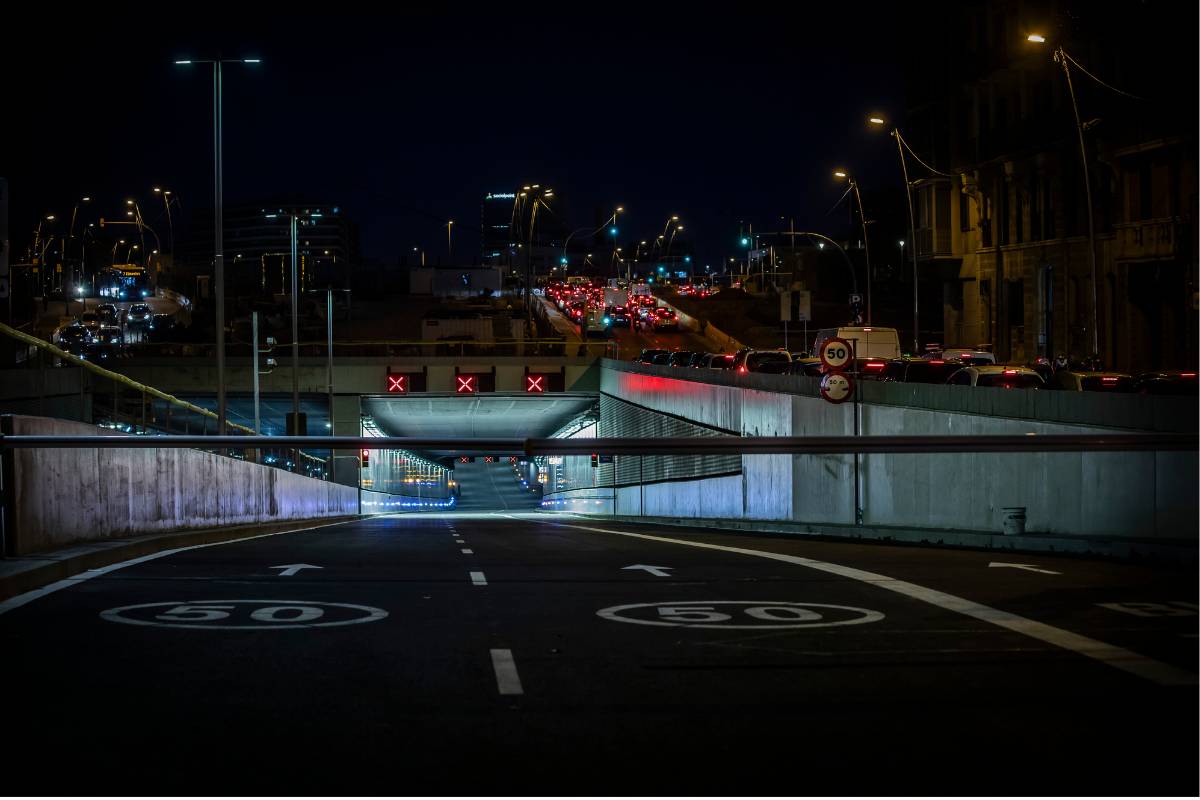
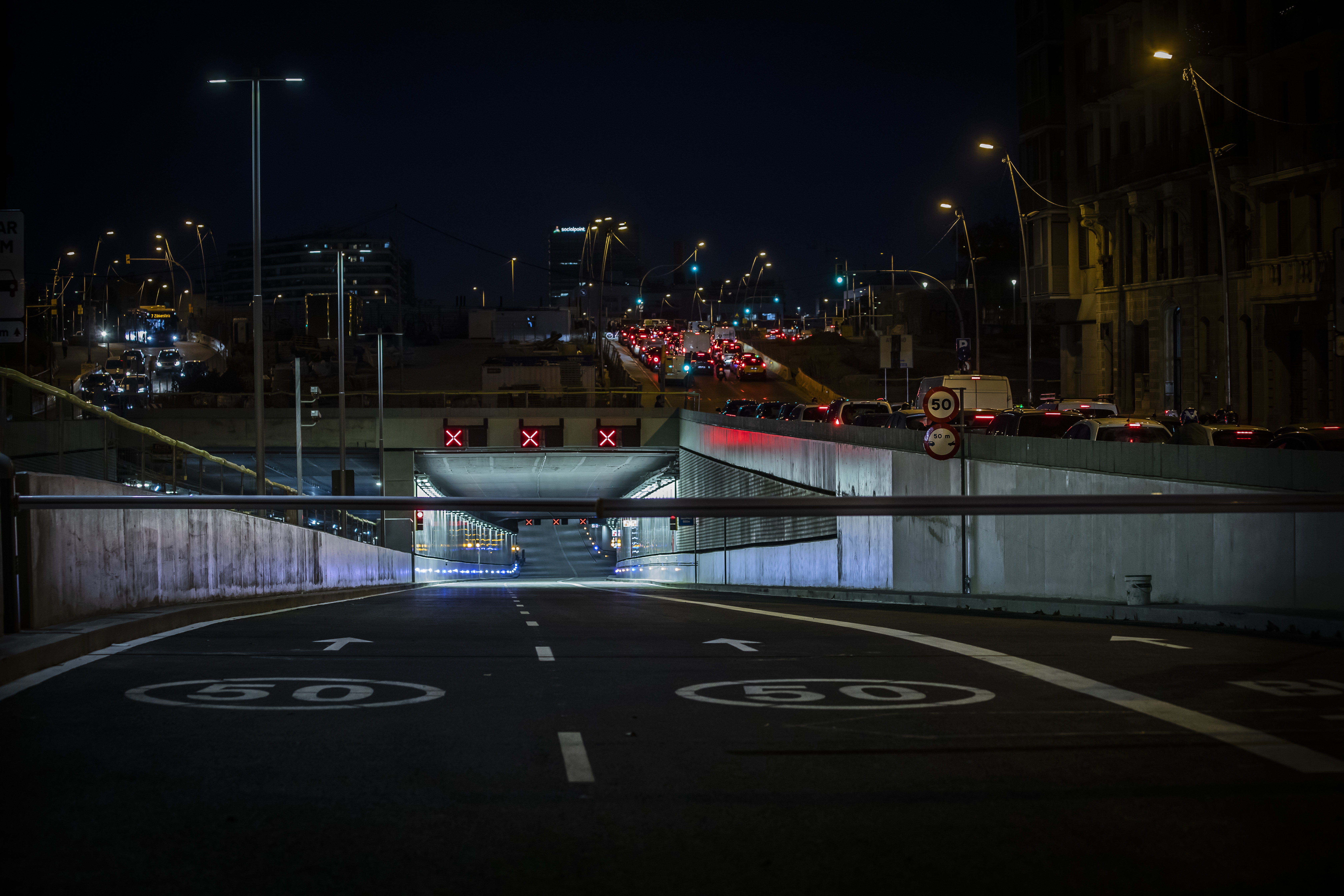
- In the access zones, variable message signs (VMS) must be situated between 300 and 500 metres before the portal, informing about the tunnel status, maximum speed, or possible restrictions.
- Inside, variable speed limit panels are required every few hundred metres, lane control signals in bidirectional or multi-lane tunnels, and systems capable of showing specific messages in case of fire, roadworks, or lane closure.
- At the exit, signalling must facilitate the transition towards the exterior road, normalising speed and traffic flow.
One of the most relevant, and often underestimated, aspects is the redundancy of the system. The regulations oblige equipment to maintain its functionality even if the main electrical power supply is interrupted, using Uninterruptible Power Supply (UPS) systems with a minimum autonomy of one hour.
Finally, the Royal Decree is not limited to the physical installation of panels: it requires their integration into a centralised control and supervision system. This means messages must be modifiable remotely and in real-time, with a response of less than five seconds, and equipment must feature automatic diagnosis, event logging, and bidirectional communication with the control centre.
In emergency situations, this immediate reaction capability can be decisive in preventing accidents and guaranteeing user safety.
Technical design and location standards: Instruction 8.1-IC
Instruction 8.1-IC is the Spanish reference for design, dimensions, and location of vertical signalling, including variable signalling
. This standard complements Royal Decree 635/2006 and defines precisely how signs must be implanted to guarantee their legibility, uniformity, and efficacy under any visibility condition.
Beyond a design framework, Instruction 8.1-IC translates tunnel VMS regulations into practical criteria: it determines the minimum size of characters, the necessary luminance in each zone (interior, portal, or exterior) and visual consistency between different sections of the road network.
Its rigorous application makes the difference between a system that complies with the law and one that really improves driver safety.
Design principles and legibility in tunnel environments
The 8.1-IC is based on four essential principles that become especially relevant inside a tunnel: clarity, simplicity, uniformity, and continuity.
Messages must be unequivocal and transmitted at a glance, avoiding overloading panels with multiple simultaneous warnings. Symbols, colours, and formats must be coherent throughout the network, so that a driver traversing various tunnels always finds the same visual language.
Furthermore, information must be offered with sufficient advance notice and remain visible until the user completes the indicated manoeuvre.
This ergonomic approach, the result of years of research on perception and reaction time, seeks to ensure the driver does not have to “interpret”, but rather recognise and act instinctively in any situation.
Technical requirements: dimensions, luminance, and emergency signalling
From a technical point of view, the 8.1-IC establishes that the size of characters and pictograms depends on the circulation speed and reading distance.
For example, at 100 km/h a minimum character height of 300 mm is required, while at 80 km/h 200 mm suffices, increasing by 20-30% when adverse conditions like smoke or fog exists.
The standard also differentiates luminance levels according to the panel location:
- Inside the tunnel, signs must maintain at least 150 cd/m² with a minimum contrast ratio of 5:1, guaranteeing reading in constant lighting environments.
- In the portal zone, panels must adapt their intensity automatically to exterior light changes, varying between 500 and 8,000 cd/m² with a response time of less than two seconds.
- On the exterior, luminance can reach up to 10,000 cd/m², with anti-glare optics to counteract direct sunlight.
Finally, Chapter 6 of the 8.1-IC regulates specific tunnel signalling, such as standardised pictograms for emergency exits, lay-bys, or extinguishers. These signs must be repeated every 25 metres and, in complex tunnels, can be integrated into dynamic variable panels capable of guiding users towards the safest exit depending on the incident location.
Product standards: guaranteeing reliability and CE marking
While Royal Decree 635/2006 and the 8.1-IC define what must be installed and where, UNE-EN standards specify how equipment must be manufactured to guarantee its performance and durability.
UNE-EN 12966:2015 (Variable Message Signs, VMS)
This harmonised European standard is the mandatory reference for any variable signalling panel installed in a tunnel. Its compliance is an essential condition for the equipment’s CE marking.
This standard fixes photometric and chromatic classes, angular visibility requirements, uniformity, environmental resistance, and tests
Regarding photometric classification, the standard distinguishes four luminance levels (L1 to L4), with the most demanding—L3 and L4—being applicable to tunnels. Class L3 panels, with values between 4,000 and 6,000 cd/m², are used in portal zones or tunnels with reinforced lighting, while Class L4 ones, reaching up to 10,000 cd/m², are essential in exteriors exposed to high solar radiation.
The chromatic classification establishes the colour precision of LEDs according to CIE coordinates, ensuring correct message interpretation even under artificial light. Specific ranges are defined for the colours red (R1), green (G1), and amber (A1), corresponding to prohibition, indication, and caution signs respectively.
Furthermore, the standard fixes minimum visibility angles: ±40° on the horizontal plane (±50° recommended in tunnels with curves) and +15°/-10° on the vertical, guaranteeing legibility from any type of vehicle.
To accredit their reliability, panels must pass rigorous tests simulating extreme tunnel environment conditions: resistance to vibrations and humidity, thermal cycles between -20 °C and +60 °C, exposure to corrosion, and a minimum useful life of 50,000 hours maintaining 70% of their initial luminance.
Finally, IP and IK protection degrees ensure resistance against external agents.
- Inside the tunnel, the standard recommends IP65/IK10 to protect against dust, pressurised water, and impacts.
- In portal zones, IP66/IK10 offers greater tightness against powerful water jets and sudden thermal changes.
- On the exterior, panels must reach at least IP67/IK10, especially in tunnels exposed to intense rain, snow, or flood risk.
You might be interested in: UNE-EN 12966:2005 Standard for Variable Message Signs
UNE 199051-2:2016 – Communication protocols
Spanish standard standardising protocols, messaging, and diagnostics between VMS and control centres. It guarantees that equipment from different manufacturers can coexist on the same platform and that operation has useful alarms and telemetry (states, faults, temperatures, brightness regulation, etc.).
The UNE 199051-2:2016 standard is based on UNE-EN 12966 and defines the constructive, functional, and communication requirements of variable messaging panels. Its communication protocol, specified in UNE 199051-2, is a proprietary standard of the DGT in Spain (independent and distinct from the US NTCIP protocol).
Although both fulfil similar communication and control functions, they differ in structure and operation. Fixalia’s DEVA 5G panels exclusively incorporate both protocols, allowing operation with either one according to system needs.
In critical environments like tunnels, the standard fixes very strict response times: a maximum latency of two seconds for message changes, status updates every five seconds, and immediate alarm notification.
Additionally, it includes advanced cybersecurity measures, such as authentication via digital certificates, TLS 1.2 or higher encryption, and complete logging of access and modifications, thus ensuring reliable, fast, and secure communications between equipment and the control centre.
Tip: Incorporate a test script in FAT and SAT with message sending/confirmation cases, fault simulation, and alarm verification. Do not assume that “speaking” is “understanding each other“.
Do you need custom variable message panels?
Tell us about your project and we will advise you on the best smart signage solution.
Complementary documents and guides
Besides mandatory standards, reference technical documents exist that guide the practical application and maintenance of signalling in tunnels:
- Ministry of Transport Vertical Signalling Manual: Application guide for the 8.1-IC with examples and practical recommendations.
- CEDEX and DGT technical guides on tunnel safety: Gathering good practices on visibility, maintenance, and emergency response.
Regulatory compliance: beyond the checklist
Tunnel VMS regulations fix the “minimum requirement”. A good design surpasses it, adapting to the real conditions of your tunnel.
Factors conditioning the solution
- Geometric: Length, radii, and slopes affect reading distances and viewing angles.
- Traffic: ADT and percentage of heavy vehicles condition installation height, character size, and necessary robustness.
- Environmental: Portal orientation, fog, rain, or salinity force IP/IK protection adjustments and optical care against reflections.
- Operational: Message policy, emergency protocols, target message change time, and 24/7 support availability.
Frequent errors (and how to avoid them)
- Homogenising specifications in all positions: Interior, portal, and exterior do not share the same needs.
- Trusting that CE marking covers everything: It accredits the product, but does not replace correct implementation or operation.
- Underestimating communications: Without reliable diagnosis, exploitation “flies blind”.
- Forgetting maintenance and cleaning: The best photometry degrades if there is no plan.
What the administration requires in a “perfect” file
- VMS CE Dossier: Declaration of Performance, UNE-EN 12966 tests, and class matrix.
- Compliance memory for RD 635/2006 and 8.1-IC (by position: approach, portal, interior, exit).
- Layout plans with coordinates, height levels, and justified reading distances.
- Communication scheme according to UNE 199051-2: architecture, addresses, frames, alarms, and logging.
- FAT/SAT test plan and maintenance protocol in operation (checklists, frequencies, availability KPIs).
- Operational manual with standard messages and activation criteria (incidents, roadworks, meteorology).
Fixalia: regulatory compliance from start to finish
At Fixalia, we conceive regulations as a roadmap to guarantee safe, efficient, and lasting projects, not as a formality. That is why we accompany every client from the design phase, analysing the tunnel classification, regulatory requirements, and local conditions. We select equipment with CE marking and UNE-EN 12966 performance suitable for each zone, and elaborate the complete documentation accrediting compliance with RD 635/2006 and the 8.1-IC.
Furthermore, we ensure real interoperability with the control centre via UNE 199051-2 protocols, offering remote diagnosis, precise alarms, and continuous support.
After commissioning, we train operation teams and establish maintenance plans and periodic audits to maintain system legibility, availability, and reliability throughout its useful life.
Complying is the start; designing well is the difference
Tunnel Variable Message Signs Regulations give you the minimum you must demand to protect those who pass through your infrastructure every day. Excellence arrives when you adapt tunnel VMS regulations to your tunnel’s real conditions, choose correct classes and locations, ensure interoperability, and care for the operation.
Are you working on a tunnel signalling project? At Fixalia we can help you define the most suitable technical solution for your specific needs. Our team of engineers is available to analyse your project and offer you a personalised proposal without commitment.
Contact us and discover how we can convert regulatory requirements into a real, efficient solution adapted to your tunnel’s particularities.